
Uzbekistan is the most populous country among Central Asian Counties (CACs) with a population of over 37 million (46% of Central Asia’s entire total) in 2025. Uzbekistan’s journey towards economic openness has markedly increased its visibility on the global stage, drawing attention and interest from international investors and business, fostering a more competitive domestic market. Notably, the Uzbek government is committed to improving governance and transparency to lay the foundation for business, investment opportunities and sustainable growth.
Under the leadership of President Shavkat Mirziyoyev, Uzbekistan has launched a wide array of reform agendas for societal and economic transformation since late 2016, aimed at liberalising the economy and separating from its past as a mainly state‑led economy, developing conditions to make the country a promising destination for future economic partnerships.
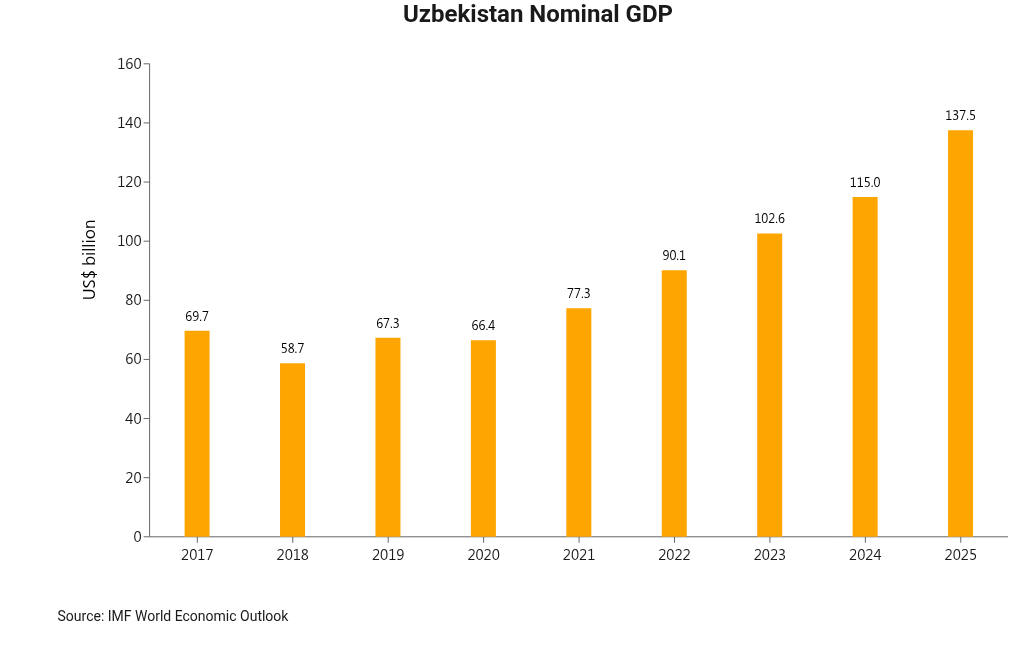
Since the initiation of economic reforms, Uzbekistan has witnessed steady progress, with economic growth beginning to accelerate. Between 2017 and 2025, the nation’s nominal GDP doubled in US dollar terms. Efforts in market liberalisation, as well as measures to facilitate trade and investment, have effectively driven substantial economic expansion. However, further structural reforms are necessary to ensure that this growth remains sustainable and inclusive for all citizens.
Reforms dimensions in becoming a modern and open economy
Before reforms were implemented to liberalise Uzbekistan's economy, most economic activities were dominated by the public sector. President Shavkat Mirziyoyev launched a series of restructuring, liberalisation, privatisation, and facilitation programs aimed at transforming state‑owned enterprises and encouraging private sector growth. These efforts were designed to enhance efficiency, stimulate growth, and pave the way for a more dynamic and diversified Uzbek economy.
Free-floating Uzbekistan Som
In September 2017, the Uzbek government liberalised the Uzbekistan SOM (UZS) to a free‑floating exchange rate and eliminated the dual‑rate system in order to support business and facilitate trade development. Before this currency liberalisation, multiple exchange rates persisted – an official rate for government transactions and a parallel market rate for businesses and individuals.
This reform reduced economic distortions and helped in revitalising formal banking services. The move also increased transparency and provided investors with a more predictable and sound financial environment, boosting foreign investor confidence.
Tax System Reform
Uzbekistan has been undergoing comprehensive tax reforms since 2019, aimed at simplifying the tax system, reducing the overall burden on taxpayers, enhancing compliance, and aligning with international standards set by organisation such as the World Trade Organisation (WTO), the Organisation for Economic Co-operation and Development (OECD) and the World Bank. Prior to the tax reform, Uzbekistan’s tax system was considered complex and burdensome due to problems such as the large number of different taxes and non‑uniform effect tax rates.
Since 2019, Uzbekistan has undertaken a series of reforms as part of its comprehensive economic liberalisation strategy. These reforms aim to attract foreign investment and business, alignment with international standards, and advancing sustainable development objectives. Notable examples include the introduction of a flat personal income tax rate of 12%, the reduction of the social tax rate from 25% to 12%, and the removal of tax benefits for exporters in 2025 to comply with WTO regulations related to subsidies and countervailing measures.
The tax reform process is still on‑going, with additional changes anticipated to further enhance the business environment, attract investment, reduce the shadow economy and foster sustainable economic growth.
Stimulating Entrepreneurship
Uzbekistan encourages entrepreneurship as one of the engines for economic growth, in particular the high value‑added technology sector. The Uzbek government considers SMEs vital for the country’s long‑term growth and job creation. To help SMEs, the government has consolidated supporting services, making them more accessible for SMEs.
The government transformed and rebranded the former Qishloq Qurilish Bank, which was specialised in financing the agricultural and social sectors of the country, into Business Development Bank in 2023. The Business Development Bank focuses on small business projects financing. Its Small Business Support Centres also provide dedicated development funds and advisory support for entrepreneurs across the country.
Institutional support like this helps deliver state programmes, such as long‑term family entrepreneurship loans and initiatives aimed at modernising production and boosting export capacity. The Uzbek government has also simplified company registration procedures, and streamlined procedures for business permits.
Since 2021, Uzbekistan has set 20 August as Entrepreneurs' Day, which provides an annual platform for open dialogue between the president, government officials, and business leaders, in order to help shape the nation’s economic and business policies. During the 2025 event, President Shavkat Mirziyoyev presented 51 initiatives, which included tax reforms, streamlined company registration processes, a new investment code, and a range of additional measures to further facilitate and support business activity.
Privatisation and state-owned enterprises restructuring
Before the economic reforms, the Uzbek economy was predominately structured around state‑owned enterprises. These monopolies in various sectors resulted in restricted market access.
The decree On Additional Measures to Ensure the Accelerated Development of Entrepreneurship, the Full Protection of Private Property, and the Qualitative Improvement of the Business Environment, signed by President Mirziyoyev in October 2016 signalled prioritising the private sector as the key driver for economic growth and job creation in Uzbekistan. The prioritised sectors include energy, banking, transport, and communications. In addition, there is also a strong emphasis on fostering private investment in areas such as manufacturing, agricultural technologies, and digital services. These measures aim to bolster the country’s export resilience and drive sustainable economic growth.
In addition to the privatisation of state assets and enterprises, public‑private partnerships (PPP) serve as a vital mechanism for attracting private and foreign investment to modernise infrastructure and enhance capacity across various sectors in Uzbekistan. The first statutory act regulating PPP was passed in June 2019, establishing a legislative foundation that has since been further developed through subsequent amendments and decrees. Between 2019 and 2024, implemented PPP projects reached a total value of US$28.9 billion, with the energy and utilities sectors accounting for the highest project values.
Looking ahead, the Uzbek government plans to implement PPP projects worth US$30 billion from 2025 to 2030, focusing on key areas such as transport, energy, utilities, and education. These forthcoming projects will fully adhere to international standards, with support from transaction advisors including the Asian Development Bank (ADB), International Finance Corporation (IFC), and European Bank for Reconstruction and Development (EBRD).
Economic structure and FDI attraction in Uzbekistan
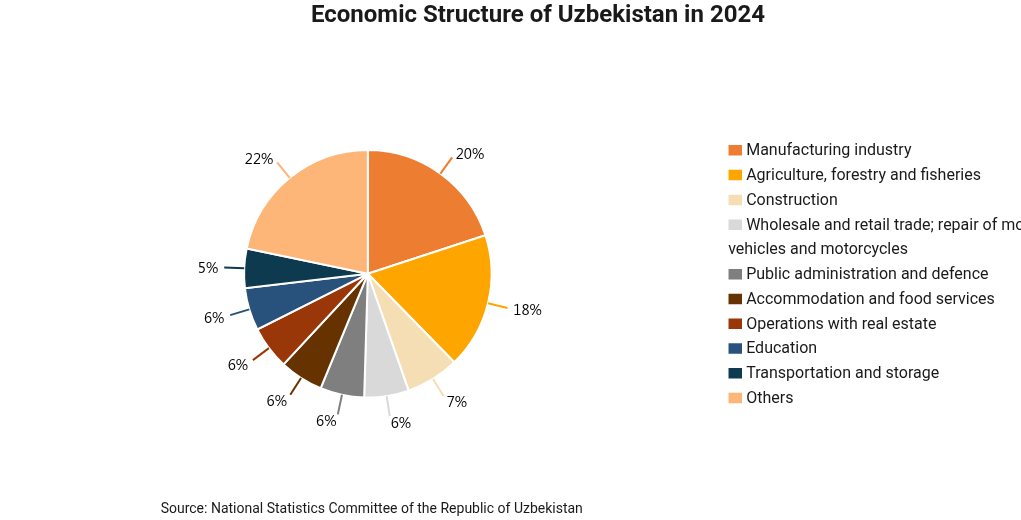
Before the economic reforms, the agriculture, forestry and fisheries sectors had long been the largest industries in the Uzbek economy. In 2024, manufacturing has expanded to become the largest sector in the country, highlighting progress in diversification and industrial upgrade.
In terms of foreign investment, there has been a constant inflow and steady uptrend of inward FDI stock. Since the economic reforms in 2017, Uzbekistan has recorded constant foreign investment inflow. Despite a slight decline in inward FDI stock in 2018, which may be due to the depreciation of UZS after the currency became free‑floating in late 2017, the inward FDI stock has increased from about US$9 billion in 2018 to over US$16.7 billion in 2024, with a compound annual growth rate of 11%.
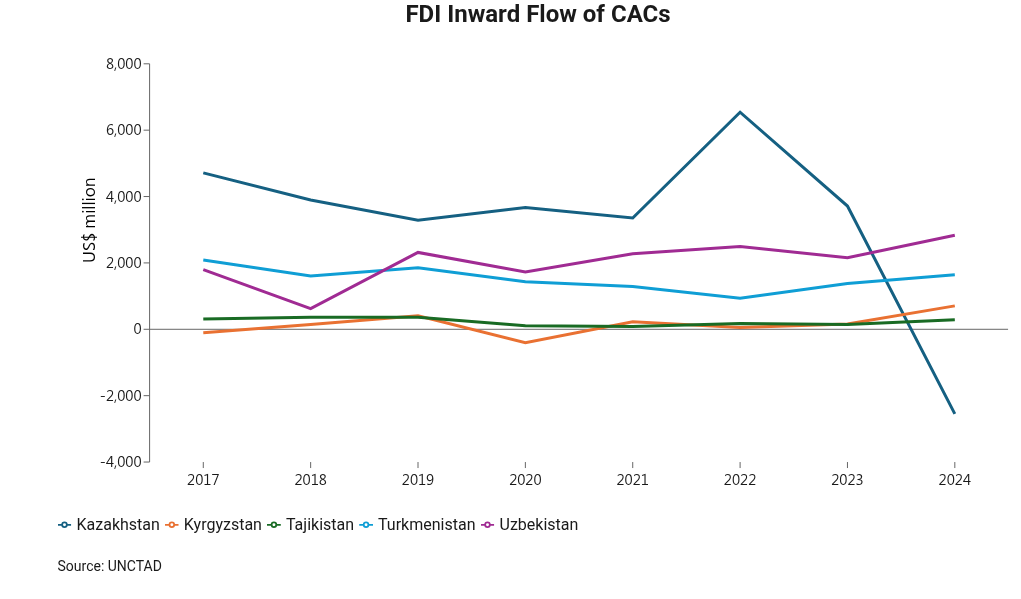
In terms of FDI flow, the inward flow has been hovering steadily at around US$2 billion each year since 2019. In 2024, Uzbekistan also became the Central Asian country with largest inward FDI flow. 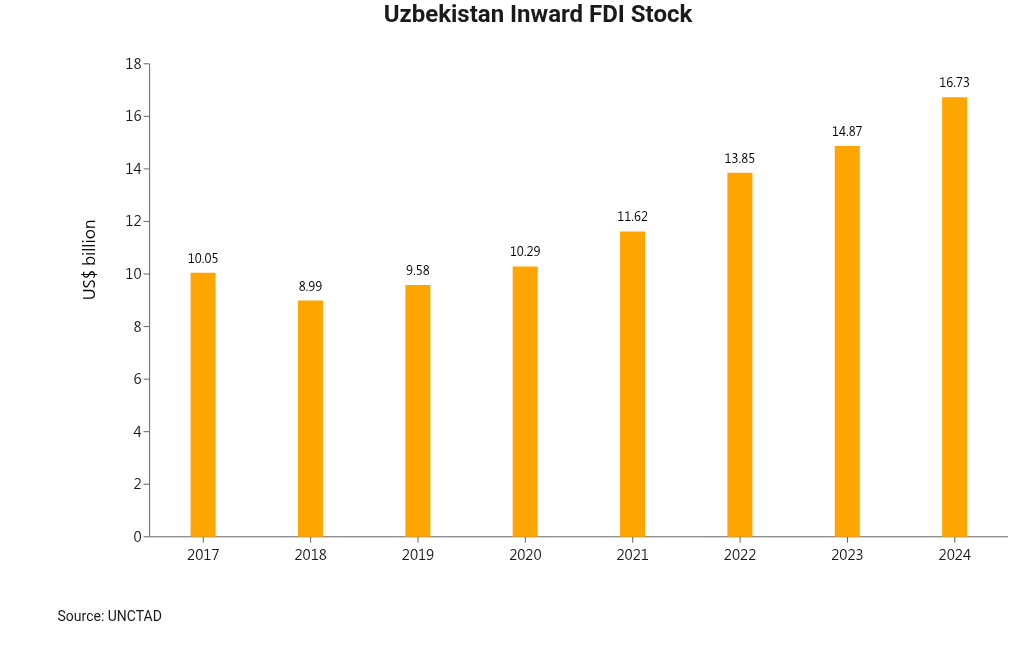
According to the National Statistics Committee of Uzbekistan, the share of foreign investment and loans in total fixed asset investment rose to 69.4% in 2024, a marked increase from just 23.8% in 2017. This substantial growth highlights the rising interest of foreign investors in Uzbekistan's fixed capital and reflects their growing confidence in the country’s potential for strong long‑term investment returns.
Uzbekistan 2030 Strategy
After years of economic and societal reform, in 2023, the Uzbekistan government set out a comprehensive plan under the Uzbekistan 2030 Strategy, which defines the key directions of the country’s development up to 2030. The plan sets out five priority areas:
creating decent conditions for realising the potential of every person
ensuring the welfare of the population through sustainable economic growth
conservation of water resources and environmental protection
ensuring the rule of law, organizing public administration oriented to service of the people
consistent continuation of the policy based on the principle of “A safe and peace-loving state”
There are 100 goals set out among the five priority areas, with targets including reforms in various sectors, such as the education system, public health, provision of social services, environmental and water conservation, public administration organisations, and the judicial system, among others.
Key economic targets to be achieved include increasing the country’s GDP from US$115 billion in 2024 to US$160 billion by 2030, and raising per‑capita GDP to US$4,000 from US$3,113 in 2024, so as to become an upper‑middle‑income country through sustainable economic development.
The Uzbekistan government is also targeting enlarged industrial capacity and productivity, including attracting investment, continuous transition of monopolies to free markets, increasing the share of private sector and technological products in industrial production, doubling labour productivity in industrial sectors, and doubling export volumes from US$21 billion to US$45 billion by 2030.
To achieve the objective of attaining upper‑middle income country status through sustainable economic development, Uzbekistan is committed to establishing an education, healthcare, and social protection system that fully meet the needs of Uzbeks and aligns with international standards. The strategy also encompasses the creation of favourable environmental conditions for the population, the development of a modern state dedicated to serving its people, and the assurance of the nations’ sovereignty and security.
Looking forward
Uzbekistan has been improving its business and investment environment through market liberalisation. This provides numerous investment projects and business opportunities for overseas companies and investors.
Uzbekistan has reaffirmed its determination to join the WTO by 2026. In May 2025, the government officially unveiled the National Trade Facilitation Roadmap 2025-2030, designed to bolster the nation’s progress towards WTO accession. This roadmap sets out Uzbekistan’s preparations for meeting the binding requirements of the Trade Facilitation Agreement, while also detailing a comprehensive programme of trade facilitation reforms to be implemented over the next five years, all aimed at fostering sustainable economic growth and international standards alignment. The Uzbekistan government has also made significant strides in enhancing the nation’s institutional, legal, and policy frameworks, simplifying trade procedures, and harnessing market forces to stimulate economic growth.
For Hong Kong businesses considering expansion into Central Asia, Uzbekistan stands out as a particularly dynamic and promising destination. The country offers a range of preferential policies, including the establishment of special economic zones and an array of tax and financial incentives, which could be highly appealing to Hong Kong enterprises and investors seeking to capitalise on new opportunities.
It is important to note, however, that Uzbekistan’s market is still in an early phase of development. As such, mechanisms for safeguarding business intellectual property and the overall legal infrastructure may not as robust or efficient as those found in more mature markets. Prospective entrants should carefully assess the associated risks, particularly with respect to regulatory transparency, contract enforcement, and intellectual property rights.
Nonetheless, Uzbekistan’s commitment to ongoing reforms and its pursuit of WTO accession by 2026 signals a strong intent to align with international standards and create a more favourable environment for foreign investors. These efforts, alongside growing industrial capacity and a drive towards sustainable economic development, suggest that the Uzbek market holds considerable potential for businesses willing to navigate its evolving landscape.
