
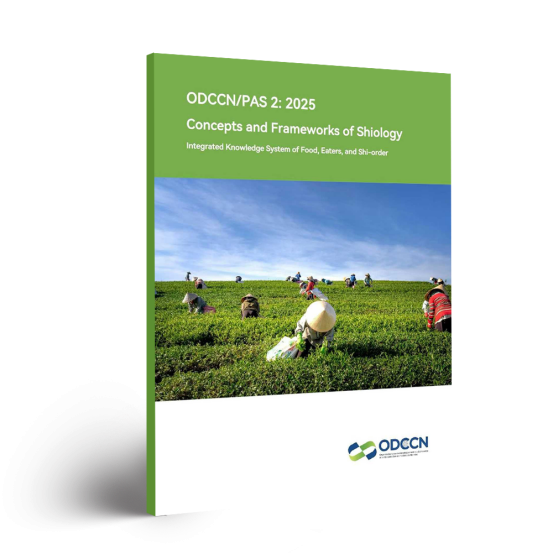
ODCCN/PAS 2: 2025 specifies the fundamental concepts and frameworks of Shiology, integrating foodology, eatology, and related aspects of social order. The document aims to address shiances (food-related contradictions), optimize global food systems, and advance sustainable development in alignment with the UN SDGs.
The release of ODCCN/PAS 2: 2025 marks a significant milestone in the development of the discipline, signifying its entry into a new stage. The document was formulated through comprehensive, multi-level discussions and analyses—from defining core concepts to constructing the disciplinary architecture. After multiple rounds of expert consultation, revisions, and refinements, an international standard characterized by authority, scientific rigor, and universality was finalized.
By establishing a unified and standardized terminology system and conceptual framework, ODCCN/PAS 2: 2025 provides a solid foundation for knowledge sharing, academic exchange, and the global dissemination of Shiology. It lays the groundwork for future research, interdisciplinary collaboration, and the practical application of Shiology in addressing global food challenges.
The Asian Expert Group Meeting on ODCCN/PAS 2: 2025 was convened on May 28, 2025 in Beijing. Organized by ODCCN in a hybrid format, the meeting gathered experts and scholars from China, Pakistan, India, Nepal, Indonesia, Oman, Qatar, and Cambodia.
Professor Sri Fatimah of the University of Padjadjaran offered detailed recommendations on the terminology and structural framework of Shiology. She acknowledged its broad scope as a systematic exploration of eaters, food, and shi-order, but advised that further refinement of terminology would help avoid conceptual overlap and improve clarity during the standard-setting process.
Dr. Kimlong Chheng, President of the Asian Vision Institute (AVI), emphasized the critical role of building a standardized Shiology system. He suggested optimizing the categorization of terminology to enhance the standard’s practical utility.
Professor Rudra Bahadur Shrestha from Purbanchal University lauded the Shiology standard as a forward-looking and innovative initiative. He expressed strong support for the project and pledged to further engage in collaborative efforts.
Experts from Pakistan, India, Oman, and Qatar also actively participated in the dialogue, sharing insights and suggestions to strengthen the standard’s international applicability.
The European Expert Group Meeting on ODCCN/PAS 2: 2025 was convened on July 13, 2025 online via Zoom. Hosted by ODCCN, the meeting brought together experts from China, Romania, Bosnia and Herzegovina, Belgium, Belarus, Slovakia, and Italy.
Professor Vesna Mrdalj from the University of Banja Luka in Bosnia and Herzegovina affirmed the originality and forward-looking of the standard, and pointed out that the standard should strengthen its connection with the UN Sustainable Development Goals (SDG) to provide practical guiding significance for the sustainable goals.
Professor Hossein Azadi from the University of Liège in Belgium focused on the systematicness and practicality of the standard. He suggested clarifying the application and positioning of shiology from micro, meso, and macro levels to enhance the practical guiding significance of the shiology standard.
Dr. Iulia, President from the Culture Association of Eastern Europe, emphasized that shiology research should be fully integrated with the cultural dimension. She pointed out that factors such as philosophy, religion, and heritage in various regions around the world have an important impact on dietary behaviors; different cultures have different perceptions of food. Both China's "Yin-Yang" concept and European dietary thoughts should be included in the international standard to enhance the cultural adaptability of the standard.
In addition, Professor Maryia Samakhavets from Polessky State University in Belarus, Professor Lubica Bartova from the Slovak University of Agriculture in Nitra, and Professor Alessandra Guidi from the University of Pisa in Italy also expressed their opinions and put forward guiding suggestions for the improvement of the international standard for shiology.

©2025 The Alliance of the Chambers of Commerce and Industry of the New International Land-Sea Trade Corridor
京ICP备10054514号-1